
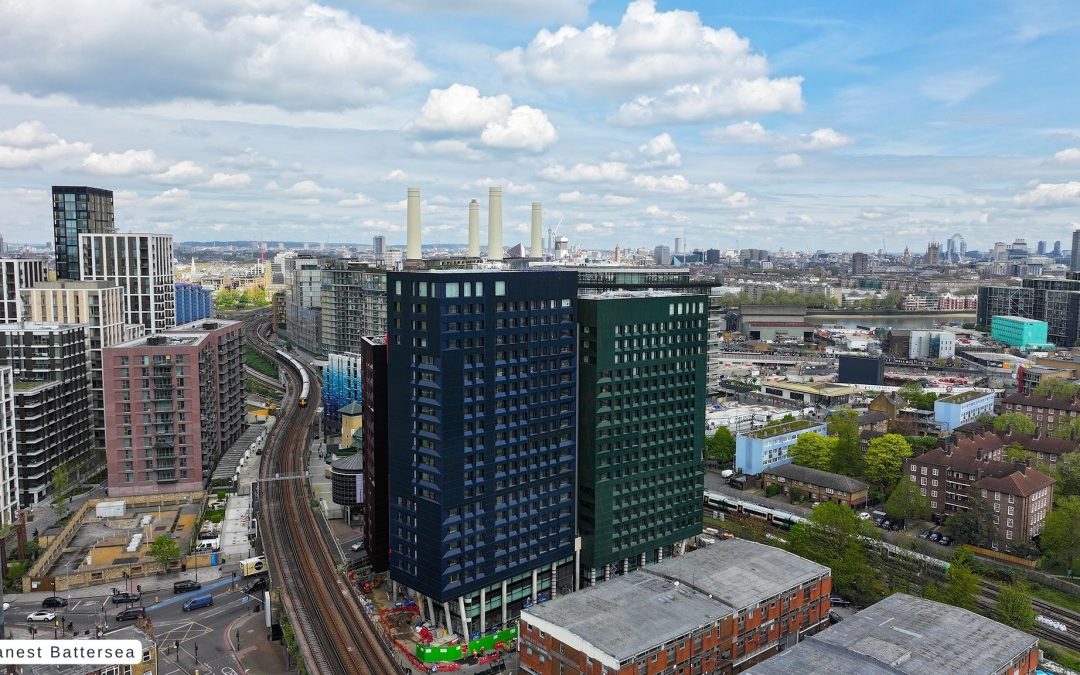
I was recently asked to do a keynote speech at the inaugural ‘Walsh Talks’, hosted by Andy Stanford, Director of Walsh Consulting Engineers. The expert panel, comprising John Linklater and Vicky Skinner from Urbanest, Bram van der Wal of Apt, Thomas Henriksen of Henriksen Studios, and Rob Barbour from Cast Consultancy who all spoke from first hand involvement with Urbanest’s projects, were discussing Urbanest’s use of Passivhaus technology and other Modern Methods of Construction (MMC) in their most recent schemes. This article is a summary of my research for keynote speech.
Passivhaus is a system designed to reduce energy consumption for heating and cooling by up to 90%. My intention in this article is to set the scene as to why Urbanest have decided to pursue these innovative, sustainable building technologies in their schemes. Urbanest Battersea is the first Passivhaus PBSA in London, and is the largest single Passivhaus building in the UK. When complete Urbanest Trafalgar Way will be the largest Passivhaus PBSA building in Europe. The context for this emerging trend seems to be at the convergence of three major trends.
Firstly, student accommodation operators are facing a much more complex and unpredictable operating environment.
For the last 15 years, it’s been largely plain sailing in the PBSA market. Demand for PBSA has been consistent. The student population has continued to grow year on year, the sector has attracted international capital at scale and supply has struggled to keep pace with the growth in students. Leasing outcomes for most of that period have been consistent, with rapid stabilisation, rental growth and high occupancy being the norms, and performance across various markets being consistent. But the effect of student preferences is starting to be felt around the edges of the system, leading to less predictable leasing cycles. Application growth has been strongest around the higher tariff universities, which grew by 7.4% in the 2025 cycle, compared to 2.3% in the medium tariff universities, and a drop of 2% in the lower tariff group. Subject preferences are also changing: engineering and subjects allied to medicine are up; IT and Business Studies are down. 1 This will have significant implications for the best PBSA locations.
Although international student acceptances were up by 6.8%, and the number of UK 18-year olds were up by 3.5%, there has been a 3.3% decrease in mature students over the age of 22 entering the system. This group are not as insignificant as you might think, representing 18% of accepted places and outnumbering international students.
The proportion of 18-year-old students intending to live at home in 2025 was 31%, up from 22% a decade ago. 3 Not surprisingly, this is most keenly felt among the poorest, with 52% of English18-year olds in IMD Quintile 1 planning to live at home. 4 The demand pie is not so much shrinking but is changing shape, making it less predictable. As students and families become more price-sensitive, schemes offering a balance of price, location and quality are likely to outperform premium schemes. As a result, operators are increasingly under pressure to offer long-term value for money to students.
Secondly, there is increasing concern around climate change and energy consumption. Extreme weather events are a problem for buildings – making them either too hot or too cold. PBSA schemes have a reputation for being generally overheated, with little accountability for usage. Energy prices have become more unpredictable and influenced by geopolitical events. High energy consumption makes operators more susceptible to energy price volatility. And there is also a growing trend towards eco-friendly lifestyles and preferences for buildings aligned with sustainability values.
Thirdly, we are in the most complex delivery environment living sectors developers have ever known. Lengthy planning processes, rising build costs, affordable housing contributions, building safety and higher interest rates have all contributed to longer development timescales and it’s much more challenging to make the numbers stack up.
The rise of Passivhaus is in part a response to these trends. The Passivhaus system was created in Germany in the 1980s, but advances in building technology such as high-performance insulation, triple glazing and airtight membranes and ventilation systems have made Passivhaus easier and more affordable to achieve.
The benefits of Passivhaus are numerous. There is a significant reduction in energy consumption, leading to long-term energy savings and lower price volatility. Passivhaus technology is an on-cost which can be add around 8-12% to build costs in a building built to standard building regulations. However, there are savings when combined with MMC. For example, according to our pan ellists, combining Passivhaus with a unitised facade can reduce this on-cost to 3-5%. Passivhaus has synergies with other MMC, as they share the same core aims of precision, performance and predictability. The combination of Passivhaus and MCC together can also reduce construction timescales materially. Urbanest commented that their Trafalgar Way scheme is 8 months ahead of schedule and may open a school year earlier, leading to finance savings and boosting returns and viability.
Passivhaus buildings are often seen as exemplars of sustainable urban development, and are therefore appealing to planners, funding parties and
universities. But perhaps the most important aspect of future-proofing of all is the focus on a healthy living environment within Passivhaus buildings, with improved air-quality being one of its benefits. This is likely to engender positive feedback from students. And due to the potential energy savings, Passivhaus PBSA buildings will put operators in the best possible position to offer long-term value for money to students. Urbanest are to be congratulated on being at the forefront of adopting innovative building technology.
Jo Winchester FRICS
March 2026
On the expert panel were:
John Linklater, Project Director, Urbanest
Vicky Skinner, CFO, Urbanest
Bram van der Wal, Architect, Apt
Thomas Henrikson, Founder and Director at Henriksen Studio
Rob Barbour, Director, Cast Consultancy
The panel was moderated by Andy Stanford, Director, Walsh Engineers